"Enemy of the State"
How Close are We to the Movie?
In the few years since "Enemy of the State" was made it has gone from a fun movie with fairly silly paranoia about the surveillance capabilities of the government to a sobering realization that many of the capabilities are either already on the shelf or not so far from being on the shelf.
The reason for watching this movie is to reflect on how technology affects our lives and on how our concepts about technology, both accurate and exaggerated, influence our perceptions of the world around us. Often the devices which can be used against us are devices designed for helpful purposes, protective purposes. Many surveillance devices started as personal services and conveniences, for our benefit and safety. We will divide them into external and personal devices, means and methods.
One imporant ingredient to fictional paranoia is the government. In "Joseph K" Franz Kafka creates a story of a man arrested who is never apprised of the charges and whose every action, no matter what, is construed as further sign of guilt. In "Fahrenheit 451" the government is behind the manipulation and monitoring of individuals. Yet today most of the devices either created for surveillance or used for surveillance are corporate developments. And government officials are now using private firms to do things for them which they themselves are forbidden by law. This goes all the way from hiring mercenaries (calling them security) to using satellite domestice photos from private firms' satellites because the government agencies are forbidden to use satellites for domestic surveillance. A collusion between government and corporations. An end-run around constitutional and legislative protections of privacy and more.
In the end it is the people using and deciding on the use of technology rather then the technology itself. At the same time, when you have a device in hand it will almost certainly be used, sooner or later. Whether low-tech or hi-tech, human or device.
A Few Movie Note Points
- who makes a video tape?
- legal videographers may not want "evidence" tape on property for security reasons
- why would you ever talk about it before making dups - loose lips sink all our ships
- using street cams to send message (here a finger) but these have also been used to send message at a pre-arrange time for someone to wave to home under a web-cam to say, "I got here"
- getting an ID on the license tag is old tech
- do new databases offer faster check?
- across jurisdictions?
- how are databases being combined
- what are tech issues in combining
- what are turf war issues
- How far can you enlarge an image from video (resolution is limited)
- "secure line" - scramblers and other devices available since WWII at least
- low-tech: use human contact (neighbor woman) to gain entry
- reliance on hi-tech cost us in Mid-east
- brings up humint versus techint
- data storage devices - evolution of - punch cards, paper tape, drives, chips, etc.
- views of the area
- overhead aerial views
- how much live can we see now vs movie
- how much from satellites
- how much from aircraft
- In-Store security cams
- how is their data available now
- private firms are supplying links to police command centers - how extensive
- 3D software extrapolation from single camera view?
- in store, to get a "look" at package contents
- software now available to create 3D image - but needs more than one view
- button camera on agent
- how small are video cameras
- and their transmitters
- what range
- what batteries
- Voice-stress tests - what do they do - what do they really show
- low-tech - planting a story in papers - how easy
- those leaks you hear about? most are planted by the top officials (who complain about them)
- leaks are a way of zinging the competition anonymously through reporters
- i.e. Ambassador Joseph Wilson's wife was outed as a CIA agent in 1973 by leak to Robert Novak
- character assasination - easier and more effective than many other means (i.e. assasination)
- The guys in the monitoring van - seem to regard this as a game for them
- credit card - making it decline - how easy is access to credit card companies?
- Software which traces your movements in a building and displays "you"
- Piloted helicopter and close-to-buildings fast flying versus drones
- "devices like this" - where can you buy or otherwise get thes things
- LoJack is mentioned - we now have OnStar and others - what can they do
- Wireframe building manipulation software to view any building
- How easy is it to get any building info (fire depts?)
- What software allows this kind of visual combination of bldg plans and surveillance info?
- Handheld devices to pick up bugs
- Similar handheld devices to locate person wearing bugs (used by the villains)
- Hotel electronic locks - electronic picks - real?
- Fire in closet - low-tech method but:
- have you ever been in a fire? very dark, dis-orienting, bad visibility
- smoke inhallation
- very, very fast fire department response - who gets anywhere that fast
- Facial recognition software - where used - how much - how much more
- used in casinos to ID certain gamblers in early 90's
- first school use in late 2003 in Phoenix - database given faces of children and pedophiles, etc.
- introduced to border patrol sites in early 2004
- Satellites to see small details and to follow suspect
- How small and which kinds of satellites
- "dedicated" (???) satellite?
- many satellites but they are in orbits
- satelllites can only see so much for so long
- surveillance and other aircraft are more useful
- aircraft have "loiter" capability
- aircraft can manuever with a subject
- The game device had a PCMCIA (PC) card. Memory devices such as Compact Flash are now common
- did nature photographer pull Zip disk from computer and put PCMCIA device in game? or not?
- Call tracing versus Caller ID - movie traces a call (quickly)
- Copper-wire mesh to shield against radio bugs, emissions (a Faraday cage though not named in movie)
- Encryption of video file on PCMCIA disk - file encription programs - how do they work?
- NSA - National Security Administration - how many government orgs can run special ops?
- GPS in phone
- most major cell providers will have this by the end of this year
- locating ability mandated by law for cells for 911 calls by end of 2006
- Computers listening to phone calls and looking for key words?
- what software listens for words now?
- what software looks for words in email, etc, now?
- how can phones be tapped now?
- in 60's multiple phones lines could be tapped by picking up microwave transmissions (Soviets did it all the time to us) because a great deal of phone transmission is via microwave, from tower to tower.
- in movie phone transmissions from satellite are "tapped"
- how far is the satellite
- how much conversation delay
- using a cell phone and laptop to tap a phone (method, software?)
- was the cell just used as a modem? we do have direct wireless for laptops, etc.
- the software would access what? - switching exchanges?
- How fast and at what range can someone track a bug?
- What about power supplies for the bugs? needed?
External Devices
In the movie, Will Smith's character is tailed by satellite and helicopter. There are even wire-frame diagrams of buildings on computer screens with infrared images of Smith's character. Small cameras are placed in his home to spy on him.
Cameras
Government satellites still have the smallest resolution (the smallest item which can be imaged from space), about 10 inches. These intelligence satellites' agencies are legally restricted from taking pictures of the U.S.
Commercial satellites have lower resolution but they are not restricted by law from taking pictures of the domestic U.S. So the government has been buying a lot of pictures from the private satellite firms and also loosening restrictions on those firms' ability to have better and better equipment.
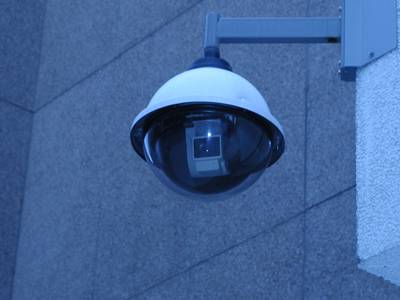 Surveillance cameras in stores and on streets are usually separate cameras from un-connected companies (photo at left is a DC public security camera). Washington, DC has had a JOCC (Joint Operations Command Center) since well before 9-11. The police department's JOCC has several hundred cameras connected to a central command center. You can be followed by camera, at least across some areas of the network. Other cameras can be connected from private firms. Think of the scene when Will Smith is seen buy his wife a gift.
In the movie the villains have access via computer connections to cameras in any number of locations which can be accessed by a few key strokes. For the moment there are large problems in interconnecting databases and surveillance sensors. It takes a lot of work and many systems are not compatible. But this is a matter of time and effort.
The ability to ask for surveillance at some particular spot requires a geographic location match in a database to tell the central controller which camera or cameras or listening devices to activate into a central feed.
In the movie it only requires a few quick keystrokes usually with the sound of frantic typing.
Along with that are cameras hooked into facial-recognition software. They have already been used for some time. In Las Vegas they have been used to detect gamblers able to make money off the house. In London the average person is imaged at lease 300 times a day by more than 150,000 cameras in central London.
Traffic cameras are set to record car license numbers and automatically change drivers for infractions.
Private business is providing the data muscle for government. The CAPPS II program which is a passenger profiling plan to identify possible risks is government puchased information from private data mining using a program which compares a large number of items from credit rating to purchases.
MATRIX is a software program which (like CAPPS II) combines police records and commercially available data on ordinary citizens for total surveillance.
Overhead Aircraft - Surveillance Drones
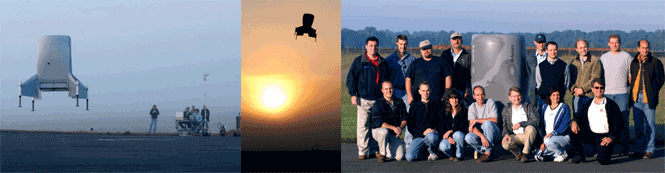
Another private program from Aurora Flight Science (photo strip above) has a number of un-crewed surveillance drones including one called "Golden-Eye" which can hover at 50-500 feet for up to 4 hours and is silent some 150 yards away. It is a ducted-fan outfit and looks a lot like a trashcan floating in the sky at $178,000. They are also building a much smaller one at only $50,000 designed for local police departments - both are a lot cheaper than trained pilots and helicopters (at several million per craft). Aurora Flight Sciences - http://www.hiflight.com
A slightly paranoid title "Flying Fascism .." of a more sedately titled original. Actually I found a number of copies of this article on the web. Some were admiring (see what we can do now) and some, such as this one were openly fearful and hostile - http://www.thetruthseeker.co.uk/article.asp?ID=2270
Papers on what the ACLU and others are calling the Surveillance-Industrial Complex - http://www.aclu.org/Privacy/Privacy.cfm?ID=16229&c=130 - a lot of the developments and implementation are coming from private corporations rather then purely government as our paranoid-fantasy novels and movies across the last numerous decades (longer actually) focus on. A large percentage show fear of government and a few show fear of the power of private wealth.
Personal Devices
Will Smith's possessions become spies for him. He finds that small tracking devices have been planted on him. His cell phone is not private. Even his own television feeds images to him of himself in a sort of "conversation" showing the capability of someone at the other end. His purchases can be trailed and his bank-account records can be changed.
RFID chips
RFID = Radio Frequency IDentification - An RFID tag is a "transponder" which activates when a transceiver (transmitter / receiver) emits a signal via an antenna. The range can be as small as a few feet (such as used at the exit to stores - that beep) or more than 400 feet for some systems.
So soldiers in Iraq are wearing RFID wristbands from Applied Digital Solutions of Florida. Applied Digital Solutions also makes a grain-of-rice sized RFID which can be injected beneath your skin. They carry a special coating to help tissue growth - to avoid having the body reject it and eventually push it out as it would with a splinter.
Note again that most of these devices started with (and are still used for) helpful, convenient uses. Here we can track pets, make sure our children are safe, find wandering elders suffering from Alzheimers and keep a complete track of individual slaughter cattle in case mad-cow disease or other dangerous contamination is picked up in tests.
The VeriChip - Small implantable chip - http://www.4verichip.com/verichip.htm
From the website: "The VeriChip miniaturized Radio Frequency Identifcation (RFID) Device is the core of all VeriChip applications. About the size of a grain of rice, each VeriChip contains a unique verification number, which can be used to access a subscriber-supplied database providing personal related information. And unlike conventional forms of identification, VeriChip cannot be lost, stolen, misplaced or counterfeited."
"Once implanted just under the skin, via a quick, painless outpatient procedure (much like getting a shot), the VeriChip can be scanned when necessary with a proprietary VeriChip scanner."
These and other kinds of ID tags have been used on animals for some time.
GPS Devices
Cell phones - laws are in place that by the end of 2006 all cellphones must have the ability to provide the user's location for 911 calls (it is called "e911"). A number of cell phone companies
Centrally controlled cameras can be requested automatically be software which is tracking an individual either by the GPS in your cellphone or RFID chips in cards or under your skin. Arrays of RFID readers with a range of up to 400 feet can alert the central surveillance program of your presence. Anyone being "tailed" by computer would then raise an alert and a snapshot or more from the cameras in that vicinity.
National ID badges - Oracles CEO Larry Ellison has been a large advocate of national ID badges since 911. He has a prototype of the system using Oracle, of course. These would be
ID chips in windshields - more of the same. Originally developed to recognize cars on toll roads and charge them. The program is called EZ-pass.
Self-tracking devices on cars: Many expensive cars already have a self-tracking system based on an ATX telemation system. The same system is also know as OnStar elsewhere. It was designed to recover stolen cars and to provide help for drivers stranded or in other difficulty. In 2003 the FBI used it to turn on the speaker phone in a car as a bug to record conversation.