What is a "home page"?
A home page is the first document of a web site. It is a point-of-entry for the
web site. Many people use the term home page to refer to a set of pages on the Web that
represents their presence on the web.
What is Hypertext Markup Language (HTML)?
HTML (Hypertext Markup Language) is the "language" web documents are
written in. For example, the following line of HTML:
will produce the following result in a web browser:
A few years ago if you wanted to create a home page on the Internet you had to learn
HTML. Today there are many HTML "editors" available that let you create web
documents as you would a word processing document. Support for some HTML features have
been added to existing word processors like Microsoft Word. However, if you want to create
more than a simple web page you will want to use an editor designed specifically for
creating web pages.
What is a protocol?
A protocol is a convention for communication. For example, when diplomats meet
there is a certain expected protocol for communication. Why do we have protocols? It
facilitates communication. Without protocols a non-english diplomat may hold up his middle
finger when asked if he would like one or two sugars in his coffee. (Or, equally
repulsive, an English diplomat might cross his legs in front of a Middle Eastern
diplomat.)
Protocols also have a vital role in enabling computers to work together. Computers
connected to the Internet are able to communicate because they all agree on the protocol.
The low level protocol that the Internet runs on is TCP/IP. All computers connected to the
Internet understand and communicate with the TCP/IP protocol.
What is bandwidth?
Bandwidth refers to the amount of data that can be sent across a communication
channel or wire. Just as a fire hose can transport more water than a garden hose some
Internet connections can transport more data than others. For example, if you connect to
the Internet from home through your phone line you are connecting with a relatively low
bandwidth connection. If you sign on from a public lab on the UMKC campus you are
connecting with a relatively high bandwidth connection. High bandwidth connections are
better because pages download faster and they support rich media types such as audio and
video which require lots of bandwidth.
Bandwidth is usually measure in bits per second (bps) or kilobits per second (kbps). A
typical analog modem (what you would use from home) transfers data at about 28 kbps or
28,000 bps.
One of the most vexing problems for the communication industry right now is how to get
a high bandwidth Internet connection into the home.
What is compression?
Compression allows you to do more with less.
The bandwidth of an Internet connection is fixed, and it's usually a little less than
what you would like. Compression is a software technique used to increase the effective
bandwidth of a communication channel. Here's how it works:
- The original message or data is compressed to a smaller size. (Not sure how you would
compress a message? If you have ever written a number in scientific notation you have used
compression. For example, rather than writing 1,000,000,000 you can express the same
number in scientific notation as 1x10^9. The number in scientific notation takes 6
characters rather than 13 which is a reduction of more than 50%. You can compress words
using a similar technique.)
- The compressed data is sent over the communication channel.
- The compressed data is decompressed to recover the original form of the data or message.
What is encryption?
Encryption is the encoding of information to keep it private. The Internet is a public
network. A message you send over the Internet may travel through several machines (or
switches) as it makes its way to its destination. A trained technician with the proper
access to one of these intervening computers could possibly read your message. If you want
to ensure that your message remains private as it travels across the Internet you can use
encryption. Encryption works like this:
- You encrypt the message you want to send. For example, "Hi Robin" after
encryption might be "Ij Spcjo".
- You send the message "Ij Spcjo" across the Internet.
- The person receiving your messages decodes "Ij Spcjo" to "Hi Robin."
For the above example to work the person receiving the message must know how to decode
it. The key to decoding the message above is to shift the letters "left" one
position. So, I->H, j->i, etc. You normally communicate the decoding procedure via a
trusted communication channel.
Note: It's rare for anyone to eavesdrop or intercept a message. Also, the encryption
algorithms used are much more complicated and secure than the one given above.
What is DNS (Domain Name System)?
This is more technical but I'm including it because it helps explain an error message
new Internet users often see. (I have even heard this error message mentioned twice in
news reports. In both cases it was used to make the point that the Internet is still too
complicated for the average consumer.)Before explaining DNS and how it relates to this
common error message, I have to explain one interesting detail about the Internet we
haven't yet covered.
I already said that domain names (such as vu.umkc.edu) are used to identify computers
on the Internet. Every computer connected to the Internet also has a unique number. Just
as every telephone in the world has a unique number every machine connected to the
Internet has a number. The number for the Virtual University Web server is 134.193.15.57.
In fact, you can type this number in place of the domain name in most applications. For
example, if you type:
http://134.193.15.57/CS100/
into a browser. It will take you to the same place as http://vu.umkc.edu/CS100/
Computers (and telephones) are assigned numbers because machines like numbers. People,
on the other hand, prefer words. It's easier for people to remember and type words. So how
do you allow people to enter words (like vu.umkc.edu) for a computer name when what is
really needed to find another computer on the Internet is it's number? The answer is DNS.
DNS translates domain names into numbers.
Now let's consider this error message that seems to gravitate toward new users. Figure
2 to the right shows the error message you will get if Netscape can't find the domain name
specified in the URL you have given. The message is saying that the domain name as you
have typed it doesn't exist. This is usually because you have misspelled it. |
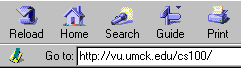
Figure 1. You enter a URL with a misspelled domain name.
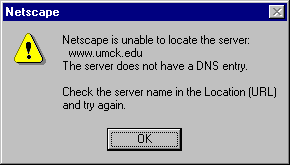
Figure 2. Netscape returns this message. |
What is Java?
Java is general purpose programming language used to develop platform-independent
programs. What this means is a program written in Java can be run, without change, on
machines from different manufacturers.
Java also has many new features that make it an ideal language for writing programs
that interact with the Internet.
What is JavaScript?
JavaScript is a World Wide Web "scripting language." JavaScript is often
used to jazz up HTML documents. For example, you can use JavaScript to check the input
value on a form. JavaScript has little in common with Java.
Can I copy words/pictures/sounds from the Internet if they don't have a
copyright (©) notice?
You can but you would probably still be violating copyright laws and could face
civil and criminal penalties. Since 1989 authors are not required to place a copyright
notice on their work to receive copyright protection. As soon as an author's work is fixed
in a tangible medium of expression (and information on the Internet is considered in
tangible form) it is automatically copyrighted.
I said you would probably be violating copyright laws because if you
copy someone else's work you are not automatically in violation of copyright laws. For
example, if the owner of the content gives you written permission to copy the work it's
ok. Or, if the reason you are making copies is for news reporting or scholarly research
you are probably safe.
I keep using the words probably, could, might be because
existing copyright law is frustratingly vague. There is some debate right now whether the
existing laws can be applied in the online world, but so far congress and the courts seem
to agree that they can be.
We have considered only one small part of copyright law here. If you are interested in
learning more, Terrence Carroll's Copyright Resource Page is a good place to start.
What are USENET news groups?
USENET news groups are online discussion groups. The best analogy to USENET is a
bulletin board. A bulletin board is a place were anyone can post or read information.
USENET is the online equivalent.
USENET consists of over 28,000 discussion groups, everything from alt.cajun
to talk.rumors including:
- alt.hobbies.beekeeping
- rec.humor
- rec.windsurfing
- sci.anthropology
USENET is not the same as the Internet. USENET is, however, distributed over the
Internet. You get access to USENET through your Internet Service Provider (ISP). Not all
ISPs provide access and some may limit what groups they carry. Once you have access you
can read and post messages to any group. Some groups are moderated which means your post
must be approved by the news group moderator before it is widely distributed.
Tip!: With over 28,000 groups and thousands of posts going to some
groups each month, actually "reading" news groups is practacly impossible.
Another alternative is to use a search engine to search through news groups for
information the same way you would search the web for information. Two of my favorite
USENET search engines are:
www.altavista.com and
www.dejanews.com
Why is indecent material allowed on the Internet?
This question falls under the topic "what is the significance of the
Internet"? Today there are no laws expressively prohibiting any subject matter from
being displayed on the Internet. Some material such as child pornography isn't allowed on
the Internet because it isn't allowed anywhere in any form.
I already said that the Internet is a new communications medium unlike any that has
preceded it. It has characteristics that distinguish it from radio, TV and print. Like
radio and TV the Internet is broadcast and can't be confined to one place, but like print
you have to seek out content on the Internet. (There is general agreement that seeking out
a magazine or location on the Internet requires more work than selecting a channel on TV
or a station on the radio.) The laws are very clear about what is allowed on radio, TV and
in print. For the most part laws covering a particular medium are based on the
accessibility of content in that medium to minors. If the Internet were enough like any
one of these existing technologies there would be no debate; we would just use the
existing laws for that technology.
In 1996 congress passed and the President signed the Communications Decency Act. In
short this legislation made it a crime to display patently offensive material on the
Internet in a way that is accessible to anyone under 18 years of age. A year later the
Supreme court declared the law unconstitutional on First Amendment grounds. In explaining
their conclusion the high court described the Internet as "...the most participatory
form of mass speech yet developed and is entitled to highest protection from governmental
intrusion".
(Those who opposed the Communications Decency Act were very quick to point out the
irony in the fact that the Starr report posted on the Internet by Congress would certainly
not have been allowed under the Communications Decency Act which was passed by Congress
only 2 years earlier.)
Most everyone agrees that some form of regulation is necessary and inevitable, but
right now it hasn't been decided the best compromise between protecting the free speech
rights of adults and the legitimate need to protect minors from harmful material.