 Background
Below is the link to the HIPAA Web page (including a link to a HIPAA tutorial) at UMKC's Web site.
Effective 14 April 2003, the new Privacy Rule of the Health Insurance Portability and Accountability Act (HIPAA) will go into effect. Developed, released, and enforced by the Department of Health and Human Services, the HIPAA Privacy Rule is intended to set national standards for maintaining the privacy and enhancing the security of an individual's Protected Health Information (PHI). This includes all Individually Identifiable Health Information (IIHI) that is in any type of format, either electronic or paper that is maintained, stored, or transmitted by a Covered Entity (CE)
In brief, this act allows patient records to be treated much like a consumer credit report. Information cannot be shared without the patient's knowledge or permission. What information that can be shared can be minimized or maximized. Patient's can have erroneous information corrected, or can have challenges to diagnosis documented permanently into their files (if they do not agree with the diagnosis.
Advantages:
Disadvantages:
UMKC faculty adopted a requirement that all faculty involved in any health-related research, as well as all students involved in the research, must complete the UMKC HIPAA tutorial. The new HIPAA regulations went into effect Monday, April 14, 2003. The tutorial (see link below) will provide you with a brief overview of HIPAA and its requirements. When you have completed the tutorial, you will be able to print out a page evidencing your completion.
http://www.umkc.edu/research/HIPAA.html
We are living in the information age. Perhaps the most important information which will be gathered during the next 10 years will be the human genome or biological blueprint for life.
Genetic analysis will enable doctors to screen people for serious diseases including cancer, as well as to diagnose, treat, and perhaps prevent these diseases.
The Human Genome Project is coordinated by the U.S. Department of Energy and the National Institutes of Health. Private companies such as Celera Genomics are also participating.
The goal of the project is to create a "periodic table of elements" for the human body. The periodic table of elements describes the building blocks of all matter. The human genome describes the basic building blocks of life.
More specifically, the goal is to: identify all of the 80,000 - 100,000 genes in human DNA and to develop tools to analyze the 3 billion pairs of chemical bases of which DNA is made.
Our discussion of this topic will focus on:
1. Information technology which is making it possible
2. Intellectual property issues
3. Ethical issues that result from having access to this information
Background
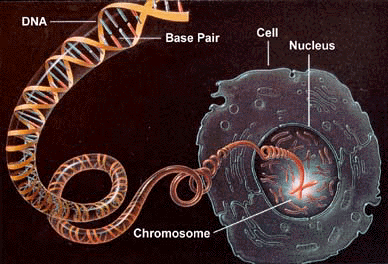
The cell is the basic unit of life. Inside cells are chromosomes. Humans have 46 chromosomes organized in 23 pairs. One chromosome in each pair is inherited from the father; the other comes from the mother.
Your DNA (deoxyribonucleic acid) is spread across your 23 chromosomes.
DNA is composed of chemical subunits called base pairs. Base pairs are represented by the letters ATGC which stand for the chemicals adenine, thymine, guanine, and cytosine. These chemicals are called nucleotides. About 3 billion bases pairs are arranged along the chromosomes.
DNA between humans (and between other mammals too) varies very little. Comparing DNA, we are 99.9% alike. You can't tell ethnicity by looking at genes. There are only 13 subjects participating in the human genome project. (Celera's project used only 5 people.)
Sections of DNA that perform a specific function are called genes. Genes are inherited "instructions" for the development and functioning of your body.
There are long genes and short genes. A gene is composed of betwee 1,000 and several million base pairs.
Genes are blueprints for proteins. Each gene tells how to make one protein (or part of a protein) and when to make it. Proteins are an important part of life. Proteins determine, among other things, how we look, how well our bodies metabolizes food or fights infection, and sometimes even how we behave. Small differences in genes between two people result in small protein differences which account for the differences between people.
A rough draft of the human genome was completed in 2000. In 2003 mapping is expected to be complete (ie we know all the genes.) The next step will be to identify the function and variations in our genes.
A gene map is likely to lead to better medications, diagnosis's, and gene therapy.
For example, a small fraction of people exposed to the AIDS virus don't get sick. Assumption is that they have a particular variant of a gene that makes them amune to the AIDS virus but this variation is otherwise harmless. If scientists can find the gene it might be possible to mimic the variation with drugs.
The Computer's Role
Bioinformatics - Applying computer technology to biological studies.
Celera Genomics is using over 300 sequencing machines in a room that is as large as a football field.
Celera has already mapped the complete DNA sequence of one person. Powerful computers and complicated mathematical algorithms are being used to identify patterns in DNA sequences.
codon - three-letter word (where each letter is ACGT) that codes for a particual amino acid. For example, ACC specifies threonine. Genes have start and stop codes. This information is used to identify genes. Given raw DNA data statistical analysis is used to identify start and top codes and the arrangement of base pairs to form codons.
introns - "junk" DNA. There is "junk" DNA between genes in your genome and even within a gene.
exons - protein coding stretches of DNA
The first step to mapping the human genome is to identify all the letters:
ACCGCACGTCTAGATC...ACGCACGTCTA
English analogy:
thefuturebeginstomorrow
The second step is to determine where the genes (words) start and stop
the future begins tomorrow
In genomics, this requires lots of heavy computation because while we do know what codon's to look for and genes have start and stop codes, there are lots of junk DNA wich also happen to contain codon's and start and stop codes. To make matters worse gene fragments may be out-of-order.
Intellectual Property Issues
Is it necessary to fully understand the gene before you can obtain a patent? What if someone else discovers more information about the role of the gene? Will someone else be encouraged to study the gene if there is already a patent on it?
Clinton and Blair statement. Originally interpreted to mean there was a shift in the policy of allowing patents on genes.
Who owns the human genome. The human genome is the collection of approximately 100,000 human genes.
Companies are using powerful data processing tools to find and patent genes, even before they know their function.
Human Genome Sciences Inc. owns the patent to a gene that was later found to be the gateway used by HIV to infect cells. Six months after HGS's patent was issued 4 independent research teams discovered the link to HIV.
Privately funded companies are also racing to identify genes. You can patent genes. If a gene has been patented derivative work based on knowledge of the gene may require royalty payments to the patent holder. Derivative work includes development of diagnostic tests that rely on the gene or medicine that interacts with the gene's function.
The Human Genome Project is ahead of schedule, quite possibly because of competition from privately funded companies.
If researchers study a gene that already has a patent they will be required to compensate the patent owner.
Should a patent go to the person who discovers a gene or discovers the function of a gene. Both are important. New direction of patent office is to require some understanding about what the gene does.
Is it reasonable to issue a patent on something that was "discovered" by computer software vs human intellect?
The US patent office is using a stricter criteria for granting gene patents. Today to obtain a patent you must show specific, substantial and credible utility.
Cells make proteins which carry out the moment-to-moment functions of life. Disease often arises when genes are defective and fail to produce their assigned proteins. Drug companies want to identify these disease related genes because it will help them target medicines.
Public companies are reluctant to disclose research because it may weaken the value of the information they do have.
Ethical Issues
5% of the budget for the federally funded project goes toward studing the ethical, legal, and social implications of genome research.
The act of sequencing the genome raises few ethical questions, but what to do with the information raises many more ethical issues.
Who should have access and for what use? Insurance companies, employers, law enforcement, etc.
How will your privacy be protected? Who owns and controls the information?
How does this additional information affect an individual and society's perceptions of that individual?
Should testing be performed when no treatment is available?
Concerning gene therapy: What is normal and what is a disability or disorder? Who decides?
Concerning genetic enhancements: Is it OK to use gene therapy to change a characteristic such as height? If is is allowed how will it affect the diversity of the gene pool?
Who will have access to these expensive technologies?